My research asks what makes people feel—and doubt—their own presence in immersive space, and how the body grounds that sense of being there. Across VR, interactive AI, and physical installation, I turn phenomenological questions about presence and embodiment into things that can be prototyped and observed.

My research asks what makes people feel—and doubt—their own presence in immersive space, and how the body grounds that sense of being there. Across VR, interactive AI, and physical installation, I turn phenomenological questions about presence and embodiment into things that can be prototyped and observed.

Presence & the body

Collaborative Research

·

2026

Seekr

View project

Seekr is a desktop research prototype combining Gaussian Splatting, an AI-generated world model, and natural-language interaction to explore human and AI spatial representations. I designed and implemented an AI perception pipeline that transforms human visual observations into navigable representations through camera-based image capture, object detection, and real-time trajectory visualization. This project became the starting point of my current research on personalized world models and spatial cognition.

Presence & the body

Collaborative Research

·

2026

Seekr

View project

A desktop research prototype that enables AI to perceive and navigate digital environments through human-guided visual observations.

Presence & the body

Independent Research

·

2024-2025

Embodiment of Virtuality

View project

Can the felt sense of presence survive the body's absence in virtual space? In this research-through-design VR project (Unity, Quest 3), users enter a scanned digital twin of their own surroundings and explore it through guided, touch-oriented interaction; across an in-progress exhibition and user testing, participants found that bodily absence heightened their awareness of presence rather than diminishing it. The work reframes touch as a means of constructing presence rather than simulating realism, and opens testable questions about how tactile and bodily cues shape presence in VR.

Presence & the body

Independent Research

·

2024-2025

Embodiment of Virtuality

View project

A research-through-design VR project investigating how touch and bodily absence shape the experience of presence in virtual environments.

Presence & the body

Collaborative Research

·

2024

Emanation and Extinction

View project

At what point do people recognize themselves inside an AI-generated image? In this interactive installation, participants' body movement drove real-time generative visuals, letting us probe the threshold of self-recognition in digital imagery. We found that both movement and image content shifted recognition sensitivity, and are extending the work to new physical environments to test how context shapes self-perception. Published at ACM IMX 2025.

Presence & the body

Collaborative Research

·

2024

Emanation and Extinction

View project

An interactive installation where body movement drives AI-generated visuals, probing when people recognize themselves in the image.

Presence & the body

Independent Research

·

2024

Immersion Lab Residency

View project

Does the body register what we read below awareness? During an Immersion Lab residency, I measured content-dependent micro-variations in hand pressure while participants read on-screen—behavioral evidence of unconscious bodily response to media content.

Presence & the body

Independent Research

·

2024

Immersion Lab Residency

View project

A residency study combining hand-pressure sensing and eye tracking to investigate unconscious bodily responses while reading digital content.

Digital–physical materiality

Independent Research

·

2023

Metal Applicator

View project

Metal Applicator is a practice-based research project exploring how applying digital materials can become an embodied interaction rather than an instantaneous command. Combining Unity, Arduino, and physical prototyping, I designed and built a system that transforms digital material assignment into a tangible, bodily action. The project demonstrates how physical effort can reshape our experience of digital materiality and interaction in 3D environments.

Digital–physical materiality

Independent Research

·

2023

Metal Applicator

View project

A practice-based research project exploring how applying digital materials can become a tangible, embodied interaction.

Digital–physical materiality

Collaborative Research

·

2024

Spolia Lounge

View project

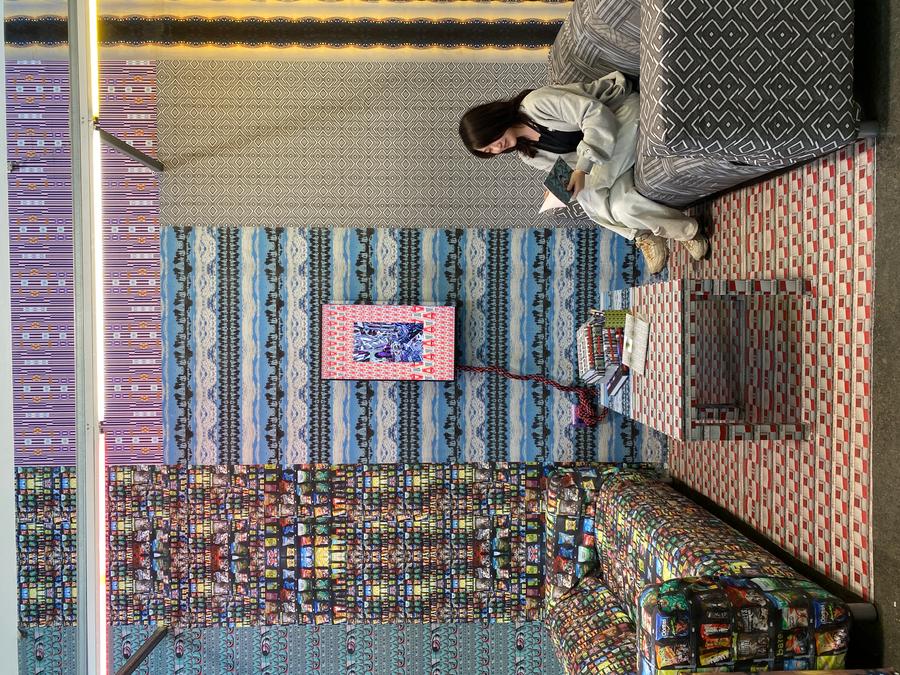
Spolia Lounge is a physical installation exploring the continuous translation between digital and physical matter. Photographs of the exhibition space were transformed into textile patterns and re-materialized onto garments, furniture, books, and everyday objects within the same environment. By enabling visitors to recognize familiar objects through their abstracted material traces, the installation makes the ongoing exchange between digital and physical space tangible.

Digital–physical materiality

Collaborative Research

·

2024

Spolia Lounge

View project

A physical installation transforming photographs of the exhibition into textile patterns that were reintroduced into the same space, creating a continuous loop between digital capture and physical material.

Applied VR

Internship

·

2025

Bringing Korean into Like

View project

Does learner agency deepen engagement in immersive learning, or is guided repetition enough? Building on Kukshinov's work on VR and perspective-taking, I designed a VR Korean-learning experience (Unity, Quest 3) structured as three interactive activities with an AI NPC guide ("Yunsun") that answers learners' own interest-driven questions from a curated knowledge bank rather than scripted prompts. The project reframes immersive learning around agency and inquiry, opening testable questions about how agency and conversational grounding affect engagement and perspective-taking in VR.

Applied VR

Internship

·

2025

Bringing Korean into Like

View project

A VR Korean-learning experience with an AI guide, developed as instructional material for Korean language learners at the University of Notre Dame.

© 2026 Situated-Virtuality